
 +86 187 3810 5965
Have you ever glanced at the production date on the bottom of a soda can while drinking it? Or noticed a batch number flashing by as electrical wires or cables were being pulled along? You might wonder: "With the production line moving so fast, how exactly are these characters precisely ink-jet printed onto the product without any pause?"
The answer is "Continous inkjet (CIJ)" printing technology.
As a veteran who has worked in industrial coding and high-volume production lines for many years, I can tell you with certainty that if a production line is operating at "lightning speed," the unsung hero behind it is most likely a CIJ coding machine.
Here in this article, we gonna introduce its working principle for you.
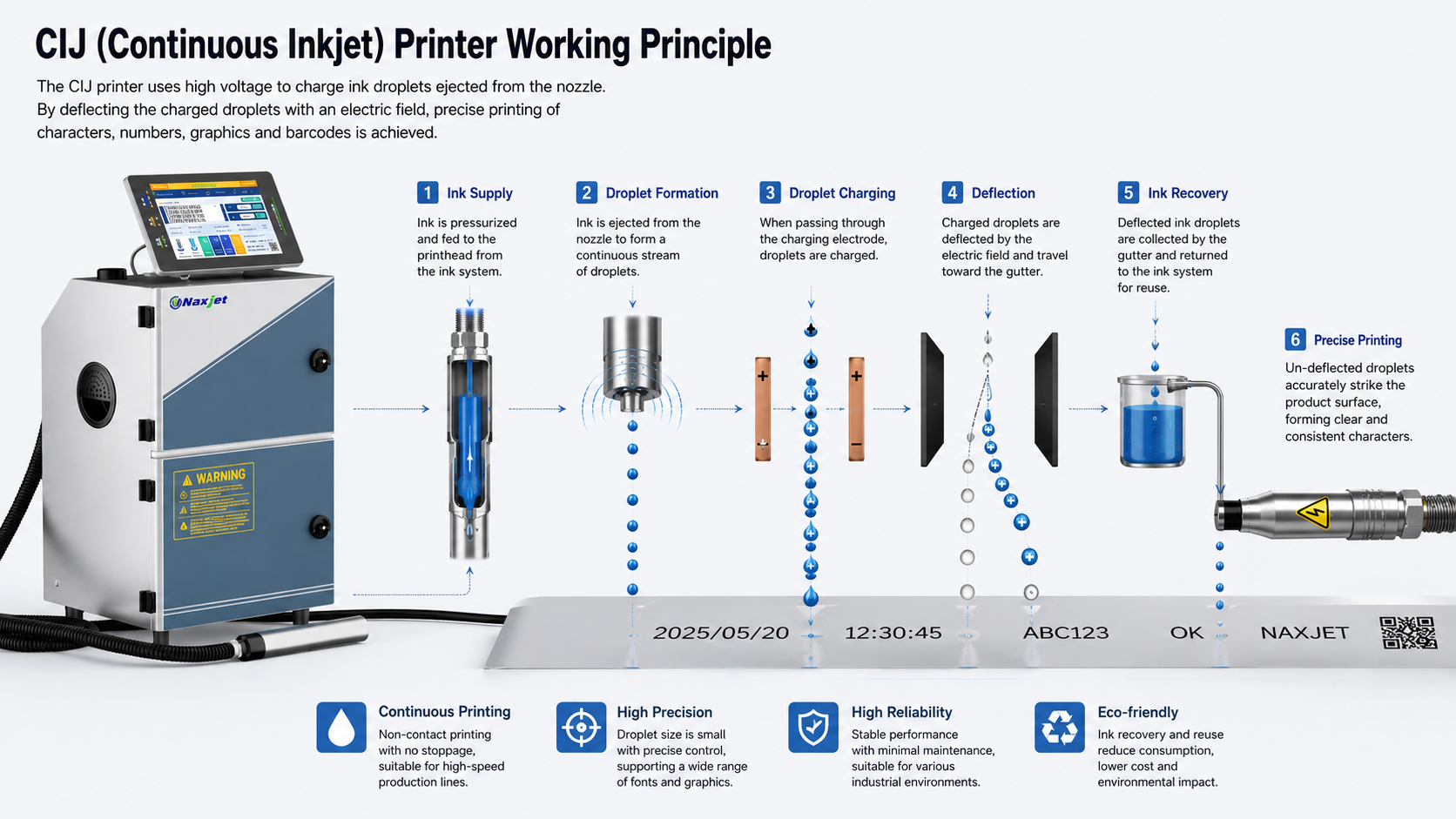
The essence of CIJ lies in its name: "Continuous." Ink is ejected in a continuous, uninterrupted stream; specific droplets are selected for printing via electrostatic deflection, while unused droplets are fully recovered and recirculated. Its core operational process can be broken down into the following five steps:
It all starts in the ink core. A high-pressure pump pushes ink from the reservoir through a series of specialized filters to ensure there are no microscopic contaminants. A pressure regulation system keeps the flow perfectly steady as it travels down the umbilical cable to the printhead.
Inside the printhead, the ink enters a drop generator. Here, a tiny piezoelectric crystal vibrates at a massive high-frequency oscillation (usually around 60,000 to 120,000 times per second). This vibration breaks the solid continuous ink stream into tens of thousands of uniform, microscopic ink droplets every single second.
As these droplets form, they pass through a charge electrode. This is where the printer's brain decides what to print. If a character or QR code needs to be formed, the electrode gives specific droplets an exact electrical charge. The unused droplets are left uncharged.
Next, the droplets fly between two magnetic deflection plates. Because these plates carry a high-voltage electrical field, they attract or repel the charged droplets, bending their flight path. This precise deflection directs the droplets through the air to land perfectly on your product, instantly forming characters, logos, or barcodes.
What happens to the uncharged droplets? They fly straight ahead, missing the product entirely, and land right into a collection tube called a gutter. This ink recycling system draws the unused ink back into the reservoir to be filtered and used again. This continuous recycling loop is what uniquely separates CIJ from Thermal Inkjet (TIJ) technology, making it incredibly fluid and efficient.
For this complex electromagnetic and physical process to operate stably 24 hours a day, the following core components must work together seamlessly:
Component | Function |
Printhead | The business end of the machine; houses the nozzle, electrodes, and gutter. |
Ink Reservoir | Holds the active ink and makeup solvent blend. |
Pump | Drives the ink through the system at precise pressures. |
Charge Electrode | Imparts a precise electrical charge to individual ink droplets. |
Deflection Plates | Uses a high-voltage field to steer charged droplets onto the substrate. |
Gutter | Catches uncharged ink droplets and routes them back for recycling. |
Controller | The brain of the printer; manages data inputs, timing, and voltages. |
Filters | Protects the system from debris to prevent nozzle clogs. |
Sensors | Detects product presence on the line to trigger the exact printing moment. |
If you’ve ever watched a beverage or canning line, the speed is dizzying—often hitting 1,000+ products per minute. CIJ thrives here because there is no "stop-start" mechanical movement.
Because CIJ eliminates any stop-and-go mechanical reciprocating motion. The ink stream is constantly flowing, and the droplet splitting frequency is on the order of microseconds, allowing it to change printing data with extremely high real-time response speed.
To strictly comply with global product traceability standards such asGS1 Packaging Guidelines and FDA product tracking mandates, CIJ printing is almost standard equipment in the following high-speed industries:
Despite the variations, the core principle remains the same: continuous inkjet (CIJ) technology remains the "gold standard" for high-speed, high-volume production lines worldwide because of its high speed, adaptability to various materials, and strong versatility. Understanding its working principles will give you greater confidence when planning equipment for your factory.
Feel free to contact our team of technical experts anytime for a customized coding and marking solution best suited to your production line needs!