 +86 187 3810 5965
The milk powder can manufacturer (from Iran) required permanent laser marking on metal cans. Each product needed a QR code containing approximately 80 characters, plus four lines of variable text totaling around 70 characters. The required production speed was at least 30 m/min, equivalent to approximately 150 cans per minute.
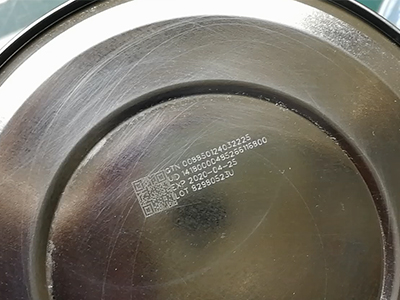
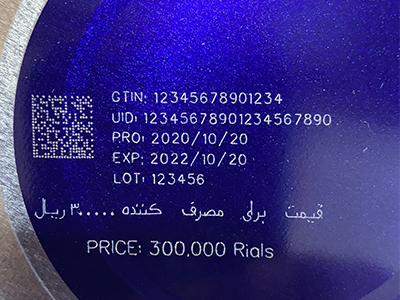
After testing, a 120W MOPA fiber laser system achieved the required result. At approximately 90% working power, the system successfully marked a 7 × 7 QR code with 80 characters and four lines of text at 30 m/min while maintaining reliable smartphone scanning.
When tested with a camera-based recognition system, speeds of up to 40 m/min were achievable.
A second test with a lower data requirement—a QR code containing approximately 30 characters plus one line of text—reached speeds of up to 120 m/min using the same configuration.
The results show that QR code data density and marking content have a major impact on achievable production speed.
For similar high-speed applications, MOPA fiber lasers are recommended because of their greater pulse control and marking stability. A minimum of 100W MOPA laser power is recommended for demanding flying marking applications involving high-density QR codes and variable data.
The complete system—including laser power, scanning performance, and production line synchronization—must be optimized to achieve reliable high-speed industrial marking.