
 +86 187 3810 5965
Plastic cards are widely used across industries from banking and telecom to retail and transportation. While, traditional card printing methods often struggle to meet the requirements of durability, flexibility, and efficiency.
With over 20 years of industry experience, we provide advanced plastic card printing and marking solutions designed for high-speed production lines, variable data printing, and permanent identification.
Technology | Best for | Pros | Cons |
CIJ (Continuous inkjet) | High-speed dates / lot codes | Extremely fast; low cost | Lower resolution (dot matrix) |
PIJ (Piezo inkjet; High resolution) | Large graphics / UV curable | Wide print area | Higher initial investment |
TIJ (Thermal inkjet) | QR codes & Barcodes | High resolution (600 DPI); clean | Requires specific solvent inks |
UV Laser | Sensitive PVC & PET | "Cold" marking; high contrast | Higher equipment cost |
Fiber Laser | ABS & Coated Plastics | Permanent; zero consumables | Can burn/melt thin PVC |
Compatible materials: PVC, composite PVC, PET, matte cards, glossy cards
Compatible materials: ABS, PC, selected rigid PVC
Send us your blank cards - We will mark them for free!
Q: What is the best printer for PVC cards?
A: For high-speed industrial lines, UV Laser or TIJ with solvent inks are the gold standard for durability and clarity.
Q: Can lasers mark cards without damaging the chip?
A: Yes. By controlling the focal length and using UV "cold marking," we can mark the surface without affecting internal RFID or IC components.
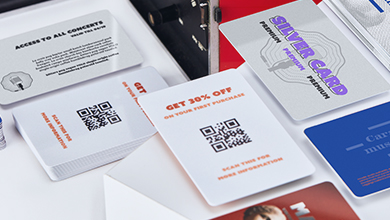
Q: How do I ensure the QR code stays readable?
A: We recommend a minimum of 300 DPI resolution and the use of high-contrast black ink or laser carbonization to ensure a Grade A scan rate.